How to Use Men's Compression Socks for Swollen Ankles: Fit, Timing, and Everyday Wear
A sock line that is still pressed into your ankle at six in the evening is not a laundry problem. It usually means fluid has pooled in your lower leg during the day, and the fix is not a looser sock. It is a sock that puts the right amount of pressure in the right place at the right time.
Here is the short answer for men dealing with swollen ankles. Choose a measured calf-length or knee-high compression sock in the 15 to 20 mmHg range for everyday puffiness, put it on before you stand up in the morning, and wear it for 8 to 12 hours. Low-cut ankle socks and tight everyday socks rarely solve the problem, because graduated pressure has to be spread along the leg rather than squeezed into a single band above the ankle bone.
Why Compression Helps a Swollen Ankle
Compression socks work on a principle called graduated pressure. The strongest pressure sits at the ankle and gets weaker as the fabric climbs toward the knee. That gradient supports the veins and the calf muscle pump, the natural mechanism that pushes fluid back toward the heart. Without that support, fluid collects around the ankle bone through the day, and the swelling is usually at its worst in the late afternoon.
Length matters for the same reason. A low-cut sock creates one narrow zone of pressure, while a calf-length sock spreads the gradient across the ankle and the lower leg. For a man whose swelling reaches above the ankle bone, calf length is the practical minimum, and knee-high is often the better choice on days with long sitting, long standing, or air travel.
This is also why an ordinary dress sock feels wrong even when it fits. Everyday socks are knitted to stay up, not to create a pressure gradient, so they squeeze hardest at the top band. That is the opposite of what a swollen ankle needs.
Match the Compression Class to Your Swelling
Compression is sold in classes defined by the pressure measured at the ankle in millimetres of mercury. Buying the strongest class on the shelf is a common mistake. More pressure is not the same as more relief, and a class that is too high can leave your toes cold, numb, or tingling by lunchtime.
Compression classes are set by the pressure measured at the ankle in millimetres of mercury, and the pressure is designed to fall as the sock rises up the leg.
Class
Pressure at the ankle
Typical use
Fitting note
Mild support
8 to 15 mmHg
Tired, mildly puffy ankles after long standing or a flight
The easiest class to put on, often sold as a travel sock
Moderate support
15 to 20 mmHg
Everyday ankle swelling, long shifts, post-flight puffiness, mild injury recovery
The usual starting point for men, and it needs a measured calf
Firm support
20 to 30 mmHg
Noticeable swelling and clinician-directed treatment
Needs an accurate measurement and a fit check, not guesswork
Extra firm support
30 to 40 mmHg
Significant swelling and lymphedema, prescribed rather than self-selected
Fitted and supervised by a clinician
For mild to moderate swelling caused by standing, sitting, or travel, the 15 to 20 mmHg class is the usual starting point. If a clinician has already told you to manage more significant swelling, or you are recovering from an ankle injury, follow that instruction rather than the label on the package.
The chart compares how pressure falls along the leg for two common classes of men's compression socks, using the ankle as the reference point. In both classes the ankle receives the full pressure and the numbers drop as the sock climbs toward the knee. In the 15 to 20 mmHg class the ankle sits near 18 mmHg, and the pressure below the knee falls to roughly 7 mmHg. In the 20 to 30 mmHg class the ankle starts near 25 mmHg and still drops to about 10 mmHg below the knee. The pattern matters more than the headline number, because a sock that holds the same pressure all the way up the calf is not graduated compression at all. Notice also that the two classes differ by only a few millimetres of mercury in the upper calf, which is why fit at the ankle decides comfort far more than the class label does.
Measure the Ankle and the Calf Before You Buy
Size charts for compression socks are built on two numbers, ankle circumference and calf circumference. Shoe size is not one of them, and a sock chosen by shoe size alone is one of the most common reasons men abandon compression after a week.
Measure within 30 minutes of waking, before you stand or walk for long.
Wrap a soft tape around the narrowest part of the ankle, just above the ankle bone.
Measure the widest part of the calf, usually about a hand's width below the knee.
Measure from the floor to just below the bend of the knee for the length.
Compare all three numbers with the size chart and follow the calf measurement when the ankle and calf land in different sizes.
Repeat the measurements if your weight changes, or if a clinician changes your treatment.
When the ankle and the calf fall into two different sizes, the calf usually decides, and a band that is too tight at the top is the one place where compression can do real harm. It is also worth remembering that a size chart describes a new sock. Fabric relaxes with washing, so two pairs in rotation will hold their gradient far longer than one pair worn every day. If you are buying for everyday wear rather than a specific prescription, the full range of men's socks is a sensible place to compare lengths and materials before you commit to a class.
Ankle circumference is not a fixed number, and the chart shows a typical pattern for a man who stands and sits through a working day. The measurement is smallest shortly after waking, at about 24.8 cm in this example, and it grows steadily to roughly 27.1 cm by early evening. That is a change of more than 2 cm, which is easily enough to move one man from one sock size into the next on a size chart. It also explains why a pair that feels perfect at 7:00 AM can feel tight and itchy by dinner time. Measuring in the morning gives you the truer and lower number, which is the number the manufacturer expects you to use. If you measure after a long day on your feet, you will very likely order a sock that is too large at the ankle and will not hold its gradient. The gap between the morning and evening figures also gets wider in hot weather, which is worth remembering if you buy a single pair for the whole year.
Put Them On Before Your Feet Touch the Floor
The single habit that decides whether compression works for you is timing. Ankles are smallest in the first 30 minutes after waking, so the sock slides on easily and holds the leg at its baseline instead of pushing fluid upward. Wait until after breakfast and a shower, and you are fitting a sock around swelling that has already started.
A method that works with firm fabric
Turn the sock inside out down to the heel, keeping the foot section intact.
Slide your foot in and check that the heel pocket sits under your heel, not on your instep.
Work the fabric up the leg in short sections with both thumbs instead of pulling the top band.
Stand up, then smooth out any fold or roll before you put your shoe on.
Check your toes for colour and warmth five minutes later, and again at lunchtime.
Wrinkles are the enemy here. A single fold behind the ankle concentrates pressure and can create a sore spot within a few hours, so take an extra 20 seconds to smooth the fabric flat. If you have limited grip or a stiff back, a plastic donning aid or a light dusting of cornstarch on the heel makes the job much faster.
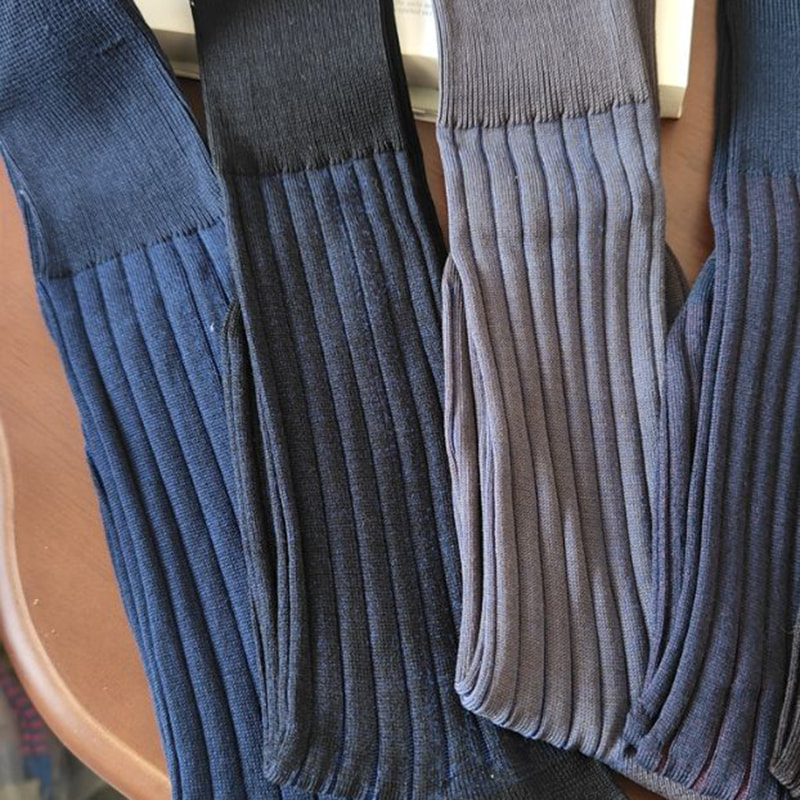
A sock that reaches the calf gives the gradient somewhere to travel. A longer style such as this one is designed for full length coverage over the ankle and lower calf:
Eight to twelve hours is the normal daily window for men's compression socks. That covers a work shift or a long flight but stops short of overnight, because ankles usually drain well enough when you are lying down. Take the socks off before bed unless a clinician has told you otherwise, and put your feet up for 20 minutes in the evening.
On travel days the timing rules tighten. Put the socks on before you leave the house, stand and walk every hour you are awake, and drink water rather than relying on salty airport food. Compression manages pooling, but it does not replace movement.
Wash the socks after every wear in lukewarm water, by hand or on a gentle cycle, and skip both the fabric softener and the dryer. Heat and softener break down the elastane that creates the gradient, so the same habits that extend the life of everyday socks apply here, and a two-pair rotation will outlast a single pair by a wide margin. These care and maintenance habits for men's socks are a good baseline for any sock you plan to wear daily.
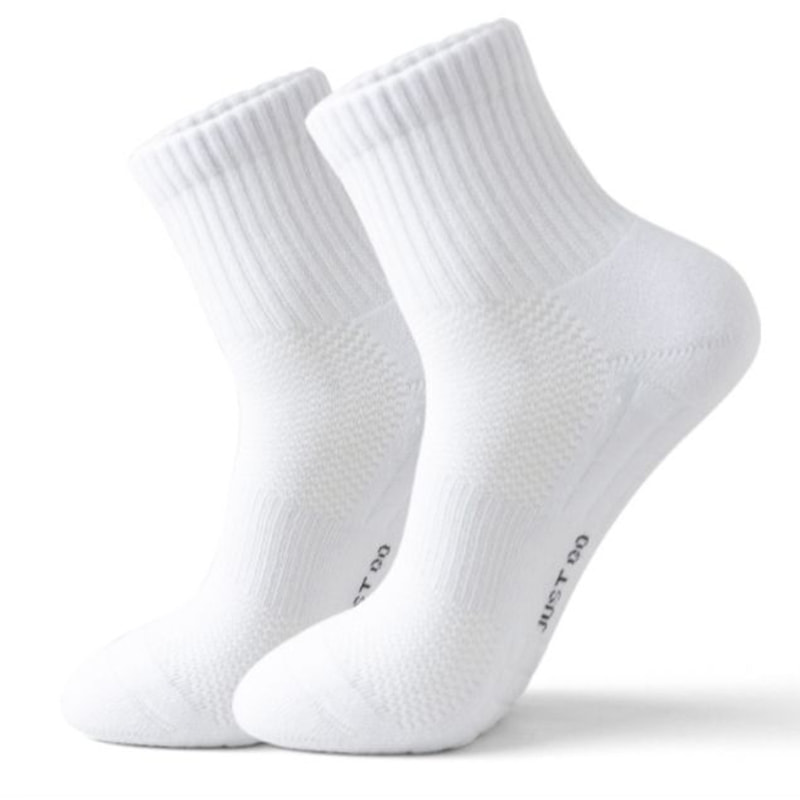
For training days, a sock with a cushioned footbed under a graduated upper is usually more comfortable than a thin medical stocking, especially in shoes that run warm. A towel-bottom sport style like this one handles the sweat and the impact:
Compression is not supposed to feel like nothing. A firm hug around the ankle and a light squeeze at the calf for the first hour is normal, and it usually settles once you start moving. What is not normal is numbness, a burning sensation, or a band that leaves a deep groove which takes more than 30 minutes to fade.
first week of wear, in cm 27.526.525.5Day 1Day 2Day 3Day 4Day 5Day 6Day 7Evening measurement, taken at about 7:00 PM
The line follows evening ankle circumference over the first seven days of consistent morning wear, starting at 27.2 cm and ending near 26.0 cm. The change is not dramatic on any single day, which is exactly why some men quit in the first 48 hours. Most of the drop happens between day one and day four, and the curve flattens after that. That shape is normal, because compression does not remove fluid permanently, it keeps the daily build-up smaller. A flat line in week two still means the sock is doing its job, especially if afternoon tightness and discomfort have eased. If the line climbs instead, check for folds in the fabric, a sock that has lost its stretch, or a medical cause that belongs with a clinician.
Comparing Sock Styles for Swollen Ankles
Three options come up again and again in this conversation, and they are not interchangeable. The chart below scores each one from 1 to 5 on the five things men mention most often, which are pressure control, calf coverage, all day comfort, ease of putting on, and breathability.
The radar chart scores three options against five things men usually care about when their ankles swell. Ankle-length short socks score well on breathability and are easy to put on, but they offer almost no calf coverage and weak pressure control above the ankle. A calf-length compression sock balances the five points, with solid pressure control, decent coverage, and moderate breathability for daily wear. A knee-high medical stocking controls pressure and covers the calf best, but it is the hardest to put on and the warmest in summer. The trade-off is worth naming clearly, because the more of the leg the sock covers, the more control you get and the more effort the sock asks of you each morning. For most working men with mild to moderate swelling, the middle option is the one that actually gets worn every day, and a sock in the drawer beats a stronger sock in the package.
Warning Signs That Mean Stop and Call a Clinician
Swelling in one leg only, especially with pain, warmth, or redness.
Sudden swelling together with chest pain or shortness of breath.
Toes that turn white or blue, or tingling that does not ease within 15 minutes of removing the sock.
Broken skin, blisters, or a rash under the sock.
Swelling that gets worse after several days of correct wear.
Compression socks manage a symptom, not a cause. Heart, kidney, liver, and vein conditions can all produce ankle swelling, and so can several common medications. If any of that applies to you, or if the swelling appears suddenly, get medical advice before you order a class of sock you may not need.
Good compression for swollen ankles comes down to three numbers and one habit. Measure the ankle and the calf in the morning, choose the class that matches your swelling rather than the strongest one on the shelf, and put the socks on before your feet touch the floor. Replace them every three to six months, or as soon as the top band stops snapping back, because relaxed fabric stops delivering the gradient the label promises.
Durch die Kombination traditioneller chinesischer Elemente mit modernen Trends und der Präsentation eines starken chinesischen Stils durch einzigartige Designs erfüllt dieser Designstil nicht nur die personalisierten Bedürfnisse junger Menschen heute, sondern auch einen einzigartigen kulturellen Charme für täglichen Verschleiß. Die fortschrittliche 3D-Drucktechnologie wird verwendet, um die Muster und Texturen auf den Socken dreidimensional und lebendiger zu gestalten. Diese Technologie verbessert nicht nur die Präzision und Klarheit der Muster, sondern macht die Socken auch erkennbarer und modischer. Als Socken mit mittlerer Länge ist ihre Länge mäßig, was die Knöchel vor der kalten Invasion der Frühlings- und Herbstsaison schützen kann und nicht zu heiß und feucht ist. Gleichzeitig sind die Wetteränderungen in der Frühjahrs- und Herbstsaison unterschiedlich, und diese Socke kann sich gut an diese Veränderungen anpassen und ein komfortables Tragenerlebnis für die Füße bieten. Die auf den Socken gedruckten Mustern sind reich und vielfältig. Es können traditionelle chinesische Muster wie Berge und Wasser, Blumen und Vögel, Drachen und Phönixe oder kreative Muster sein, die moderne trendige Elemente kombinieren.
American Tie Dye ist ein einzigartiger Färbeprozess, bei dem spezifische Bindungs- und Färbetechniken verwendet werden, um ein reichhaltiges und farbenfrohes Muster- und Farbgradienteneffekt auf Socken zu erzeugen, wodurch der Modesinn und die Personalisierung des Produkts erhöht wird. Mit einer mittleren Länge entworfen es, ist für Sportverschleiß wie Basketball geeignet und bietet ausreichend um Verpackung und Schutz des Knöchels vor Verstauchungen und anderen Verletzungen. Der Boden ist mit einem dicken Handtuch ausgestattet, das eine Feuchtigkeits-Leistung aufweist und schnell Schweiß von den Füßen absorbiert, sie trocken und komfortabel hält und das Gleiten und die Reibung während des Trainings verringert. Der Sockenkörper kann ein geschaltetes Design haben, um die Dicke und Wärme der Socken zu erhöhen und gleichzeitig den Komfort und die Weichheit des Tragens zu verbessern. Reines Baumwollmaterial, der aus reinem Baumwollmaterial besteht, hat eine gute Atmungsaktivität und Hautfreundlichkeit, reduziert den Fußgeruch und das Bakterienwachstum und die Erhaltung der Fußgesundheit. Das Produkt kann beliebte INS -Stilelemente wie Farbanpassung und Musterdesign enthalten, um es mehr den ästhetischen Bedürfnissen junger Verbraucher zu gestalten.
Die Muster übernehmen fortschrittliche 3D-Drucktechnologie und bieten ein starkes Gefühl von dreidimensionaler und Schichten, wodurch die Socken modischer und einzigartiger werden. Die Muster sind hell und langlebig, nicht leicht zu verblassen und das Erscheinungsbild der Socken für lange Zeit als neu aufrechtzuerhalten. Es gibt eine umfassende Auswahl der Muster, darunter europäische und amerikanische Straßenstile, Sportelemente, Graffiti -Kunst usw., um den personalisierten Bedürfnissen verschiedener Verbraucher gerecht zu werden. Hochwertige Baumwollmaterialien werden ausgewählt, mit weichem Touch und hautfreundlicher Komfort. Das Baumwollmaterial hat eine gute Atmungsaktivität, hält die Füße trocken, reduziert das Bakterienwachstum, absorbiert und lädt die Fußfeuchtigkeit schnell ab und hält die Füße trocken und bequem, geeignet für das Tragen in Frühlings- und Sommersaisonen. Die Socken haben eine gute Elastizität, können unterschiedliche Fußformen in enger passen und Reibung und Beschwerden während des Trainings verringern.
3D -Socken, die zu der Kategorie der kurzen Socken gehören, integrieren europäische und amerikanische traditionelle Stile in Druckelemente. Durch die 3D -Drucktechnologie werden einzigartige Muster und Designs auf den Socken vorgestellt, wodurch sie modischer und personalisierter werden. Der traditionelle europäische und amerikanische traditionelle Stil betont normalerweise Freiheit, Individualität und Avantgarde-Ausdruck mit leuchtenden Farben, einzigartigen Mustern und vielfältigen Druckmustern, zu denen Cartoons, Anime, Buchstaben, Zahlen, geometrische Formen, etc. gehören können
Mit Nachahmung von Kaschmirmaterial hat dieses Material eine weiche Berührung wie Kaschmir- und Isolationsleistung. Die Nachahmungskaschmirfaser ist empfindlich und kann eine Isolationsschicht bilden, die eine lang anhaltende Wärme für die Füße bildet. Die innere Schicht wird mit Kaschmir verdickt, um sicherzustellen, dass sie selbst bei kaltem Wetter die Füße ausreichend Wärme verleihen kann. Dieses Design verbessert nicht nur den Isolierungseffekt, sondern erhöht auch den Komfort des Tragens. In Anbetracht der Tatsache, dass der Boden während der Herbst- und Wintersaison rutschig sein kann, achtet das Produkt besondere Aufmerksamkeit auf die Leistung der Schlitten. Durch die Verwendung von speziellen Anti-Schlupf-Materialien und -verarbeitungstechniken gewährleistet es eine größere Stabilität und Sicherheit beim Gehen. Der Produktstoff des Produkts ist abgenutzt und langlebig, nicht leicht zu pillen oder zu verblassen und kann auch nach langfristigem Tragen und Waschen ein gutes Aussehen und die Leistung aufrechterhalten. Es besteht aus hoch elastischen Materialien, die beim Abnehmen unterschiedliche Fuß- und Beinformen ohne Enge oder Falten passen können.
Die Verwendung eines Plüsch- und verdickten Designs kann kalte Luft effektiv isolieren und dauerhafte Wärme für die Füße liefern. Die verdickte Plüschschicht erhöht nicht nur die Wärme, sondern verbessert auch den Komfort. Die Oberfläche der Socken besteht aus gebürstetem Schleifenmaterial, das eine gute Wärme und Hautfreundlichkeit aufweist. Die gebürstete Schleife kann mehr Luft einsperrten, eine Wärmedämmschicht bilden und den Wärmeverlust verringern. Das Längendesign des mittleren Rohrs ist sowohl warm als auch modisch, bedeckt den Wadenbereich und verhindert effektiv kaltwindinvasion. Gleichzeitig ist es auch bequem, sich mit verschiedenen Herbst- und Winterschuhstilen wie Stiefeln, Sportschuhen usw. zu kombinieren. Das Produkt hat auch die Funktion von Bodensocken und Handtuchsocken, die für das Tragen in häuslichen Umgebungen geeignet sind. Das weiche Material und das bequeme Touch ermöglichen es dem Träger, zu Hause Wärme und Komfort zu genießen. Spezielle Verarbeitung wird verwendet, um sicherzustellen, dass die Socken während des Tragens und Waschens nicht leicht Haare abgeben, wodurch die Unannehmlichkeiten und Reinigungsprobleme durch das Absetzen von Haaren verursacht werden.
Das Produkt verwendet hauptsächlich Korallenfleece-Material, ein weiches, warmes und hautfreundliches Stoff, der für die empfindliche Haut der Babys sehr geeignet ist. Darüber hinaus können einige Produkte auch Materialien wie Lammfleece kombinieren, um den Wärmeeffekt weiter zu verbessern. Coral Fleece und Lamb Fleece haben beide eine gute Isolationsleistung, die die Temperatur effektiv sperren und die Füße der Babys warme Pflege für die Füße von Babys, insbesondere für das Tragen im kalten Winter. Das Produkt enthält reichhaltige Zeichentrickmuster wie Muster mit Weihnachtsmotiven, Tiermustern usw. Diese Muster sind nicht nur süß und interessant, sondern auch die Vorstellungskraft und das Interesse der Babys an.
Die Socken bestehen hauptsächlich aus Korallenfleece- oder Lammfleece-Materialien, die beide eine Isolationsleistung haben und weich und hautfreundlich sind und Babys ein warmes und komfortables Tragenerlebnis bieten. Einige Produkte können gemischte Materialien wie Polyesterfaser (Polyester) verwenden, um die Haltbarkeit und Atmungsaktivität der Socken zu erhöhen. Die Socken sind mit verschiedenen Cartoonmustern wie Weihnachtselementen (wie Schneeflocken, Weihnachtsmann, Rentieren usw.), tierischen Mustern (wie Bären, Kaninchen usw.) gedruckt, was den Spaß und die Niedlichkeit der Socken erhöht, die für die Ästhetik der Babys geeignet sind. Das Design der mittleren Röhre kann die Knöchel und Kälber der Babys besser schützen und es vermeiden, dass die Bodensocken aufgrund ihres weichen und nicht schlechten Materials auf dem Boden tragen können.
Coral Fleece Grobnadelkleber Socken nehmen am unteren oder wichtigen Teilen der Socken ein klebendes Anti-Rutsch-Design an, das die Reibung zwischen den Socken und dem Boden oder der Sohle erhöhen kann, das Schlüpfen während des Gehens oder der Bewegung verhindern und besonders geeignet ist, auf glatten Oberflächen wie Häusern und Flößen zu tragen. Coral Fleece hat lange Fasern und dicke Luftschichten, die eine gute Isolierung und Wärmeleistung aufweisen, die zum Tragen der kalten Jahreszeiten geeignet sind und die Füße effektiv verhindern können, kalt zu werden. Coral Fleece hat eine weiche und zarte Textur und eine bequeme Berührung und kann die Haut passen, die Füße einwickeln, Müdigkeit lindern und ein warmes und komfortables Tragenerlebnis bieten. Korallenfleece hat eine gute Atmungsaktivität und Feuchtigkeitsabsorption, die überschüssige Feuchtigkeit von den Füßen absorbieren und sie durch die Poren ablösen kann, um die Füße trocken zu halten. Coral Fleece -Socken haben auch bestimmte Eigenschaften. Die antibakterielle und deodorisierende Funktion hilft, das Bakterienwachstum zu verringern und die Füße sauber zu halten.
Die Einführung eines speziellen Anti-Rutsch-Designs, wie z. B. ein Klebstoff-Schlupfboden, erhöht die Reibung mit dem Boden und verhindert, dass Kinder auf Trampolinen, Objektträger und andere Geräte rutschen. Das High-Top-Design kann sich besser um die Knöchel der Kinder wickeln, zusätzliche Unterstützung und Schutz bieten, das Risiko von Verstauchungen verringern und qualitativ hochwertige Stoffe mit guter Atmungsaktivität und Feuchtigkeitsabsorption verwenden, um die Füße trocken und komfortabel zu halten, was durch langfristige Verschleiß verursacht wird. Der speziell behandelte Gewebe hat einen hohen Verschleißfestigkeit und kann häufigen Reibung und Ziehen während der Aktivitäten der Kinder standhalten.
Erwachsene Yoga-Socken verwenden normalerweise spezielle Texturen oder Materialien, wie z. B. punktförmige Anti-Rutsch-Partikel am Boden, die den Praktiker effektiv daran hindern, während der Bewegungen zu rutschen und seine Sicherheit zu schützen. Die Anti-Rutsch-Partikel können in die Yogamatte eingebettet werden, um einen gewissen Widerstand zu liefern und zu verhindern, dass der Fuß unter Gewichtsdruck verschoben wird. Yoga-Socken bestehen häufig aus saugfähigen und schnell trocknenden Materialien wie weicher Baumwolle, Bambusfasern usw., die schnell Schweiß von den Füßen absorbieren, sie trocken halten und eine gute Feuchtigkeitsabsorption und Schweißleistung durchführen können.
Es wird ein hochwertiges Korallenfleece-Material verwendet, das eine gute Isolationsleistung aufweist und die Füße effektiv verhindern kann, dass Füße kalt werden. Das verdickte Design verbessert den Isolierungseffekt der Socken auch in der kalten Herbst- und Wintersaison und sorgt für Ihre Füße ausreichend Wärme. Das Korallenfleece -Material ist weich und delikat, bequem in Bezug auf Berührung und verursacht keine Reizung für die Haut. Es wird sich nicht unwohl fühlen, wenn es lange getragen wird. Es hat eine gute Elastizität und kann zu unterschiedlichen Fußtypen passen und es bequemer und bequemer zu tragen. Korallenfleece -Material hat normalerweise einen guten Verschleißfestigkeit und ist nicht einfach zu pillen oder zu verformen, daher ist diese Socke relativ langlebig.